


Views: 0 Author: Site Editor Publish Time: 2026-09-24 Origin: Site


PET and PE are both widely used thermoplastics, but they behave very differently as sheet materials. PET is generally more rigid, transparent, and dimensionally stable, while PE is lighter, more flexible, highly moisture-resistant, and particularly strong in chemical and low-temperature applications.
Understanding the differences between PET sheets and PE sheets is important because neither material is universally better. PET is often selected for clear packaging, thermoformed trays, displays, and applications requiring stiffness or visibility. PE is more suitable when toughness, low water absorption, chemical resistance, flexibility, or lower density matters more than optical clarity.
This guide compares PET and PE sheets across material structure, strength, transparency, barrier performance, temperature behavior, processing, sustainability, and common industrial uses.
PET stands for polyethylene terephthalate, while PE stands for polyethylene. Although both are thermoplastics, their polymer structures give them very different physical characteristics.
PET is a polyester material with relatively high stiffness, strength, and surface hardness. Clear PET sheet can provide strong optical clarity, making it particularly useful in packaging, display, printing, folding-box, and thermoforming applications.
PE is a broader polymer family that includes LDPE, LLDPE, HDPE, and other grades. Sheet products commonly use HDPE when higher rigidity is needed, while lower-density grades are used when greater flexibility is required.
This means the term “PE sheet” is less specific than “PET sheet.” Buyers should always confirm the exact polyethylene grade before comparing properties.
Suzhou Ocan Polymer Material Co., Ltd. supplies a broad range of polymer sheet and roll materials for packaging, printing, thermoforming, decoration, and industrial applications. Buyers can review the company's plastic sheet and roll products when comparing material options.
PET is commonly selected when a sheet needs to combine rigidity with transparency.
Clear PET can provide high light transmission and a glossy surface, allowing packaged products or printed graphics to remain visible. Its stiffness also helps thin sheets maintain shape during handling.
These properties make PET particularly useful for folding boxes, blister packaging, trays, protective packaging, displays, and other applications where appearance matters.
OCAN's PET portfolio includes clear, matt, and white PET sheet and roll options for different packaging and forming requirements.

PE is lower in density than PET and usually has a softer, more flexible feel.
HDPE sheet can still be relatively rigid, but it does not usually provide the same stiffness or optical clarity as PET at similar thicknesses.
PE is particularly attractive when impact toughness, water resistance, chemical resistance, or low-temperature performance matters.
It is commonly used for liners, cutting surfaces, tanks, industrial panels, protective components, packaging layers, and other applications where appearance is less important than environmental resistance.
Tip: Before comparing PET and PE, identify whether the PE grade is LDPE, LLDPE, HDPE, or another formulation. Their stiffness and processing behavior can differ significantly.
PET generally provides higher tensile strength and stiffness than ordinary polyethylene grades.
This means a PET sheet can maintain its shape more effectively under moderate load, while PE is more likely to flex or deform.
PET has a relatively high modulus, meaning it resists bending and stretching more strongly than many PE materials.
For packaging and display applications, this can be a major advantage. A relatively thin PET sheet can remain firm enough to create trays, clamshells, folding boxes, or transparent protective panels.
PET also maintains a smooth and visually consistent surface, which supports printing and retail presentation.
OCAN positions its PET sheet products for applications requiring transparency, mechanical strength, and thermoforming performance.
PE may feel less stiff, but its flexibility can be an advantage.
Rather than maintaining a rigid form, many polyethylene grades can absorb impact and deformation without cracking.
HDPE is widely used when designers need a combination of toughness, chemical resistance, and relatively low weight.
This means the “stronger” material depends on the type of stress involved. PET is generally better for rigidity and tensile performance, while PE can be better where repeated impact, flexing, or deformation is expected.
For optical clarity, PET is the clear winner in most applications.
Clear PET sheets can provide high transparency and gloss, allowing customers to see products directly through packaging or protective panels.
PE is usually translucent or opaque rather than crystal clear.
The transparency of PET is one reason it is widely used for retail packaging.
Blister packs, thermoformed trays, folding boxes, cosmetic packaging, electronics packaging, and food containers all benefit from the ability to display contents clearly.
Clear PET also provides a smoother high-gloss appearance that can make packaging look more premium.
OCAN offers PET sheet and roll products for packaging, printing, thermoforming, and related applications.
PE is more appropriate when transparency is unnecessary.
White, black, natural, colored, and opaque polyethylene sheets are common in industrial environments.
Applications such as tank liners, work surfaces, partitions, wear panels, equipment protection, and chemical processing usually prioritize durability over transparency.
If the design requires a clear panel, PET will usually be the more suitable starting material.
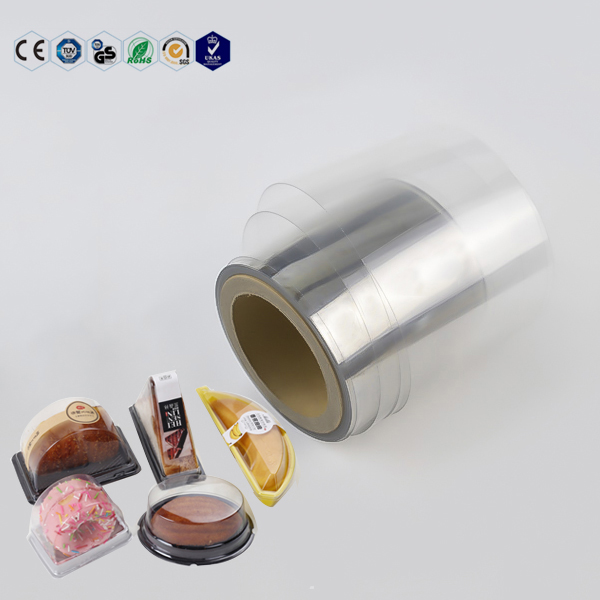
Both PET and PE provide useful environmental resistance, but their strongest areas differ.
PE generally provides exceptional resistance to water and many chemicals, while PET provides a useful combination of chemical resistance and stronger gas-barrier performance.
Polyethylene absorbs very little water and performs well in wet environments.
It is widely used in products that contact water, cleaning chemicals, acids, alkalis, and other industrial substances.
HDPE is especially common in chemical tanks, liners, cutting boards, laboratory components, and industrial fabrication because of this combination of moisture and chemical resistance.
PE also provides very good resistance to water-vapor transmission, which can be useful in packaging applications where moisture control matters.
PET generally provides much stronger resistance to oxygen and other gases than ordinary polyethylene.
This makes it valuable in packaging applications where product freshness, aroma retention, or reduced gas transmission is important.
For food, beverage, pharmaceutical, cosmetic, and consumer-product packaging, PET's gas-barrier performance can therefore be more important than PE's superior moisture-barrier characteristics.
This difference explains why multilayer packaging structures sometimes combine PET and PE rather than choosing only one material.
Neither PET nor PE should be assumed to resist every chemical.
PE generally performs very well against many acids and alkalis. PET also offers good chemical resistance but can be less suitable for strong alkaline environments or certain aggressive chemicals.
Concentration, temperature, exposure time, and mechanical stress all affect compatibility.
Industrial buyers should therefore review chemical-resistance data for the exact grade before approving a sheet for tanks, laboratories, chemical processing, or repeated cleaning.
Packaging is one of the clearest examples of how PET and PE serve different functions.
PET is frequently used when rigidity, transparency, and gas barrier matter. PE is often used when flexibility, heat sealing, moisture protection, or toughness is more important.
Packaging Requirement | PET Sheet | PE Sheet |
|---|---|---|
Clear Appearance | Excellent | Limited |
Rigidity | High | Low to Moderate |
Oxygen Barrier | Very Good | Limited |
Moisture Barrier | Good | Excellent |
Heat Sealing | Depends on construction | Excellent for suitable PE grades |
Thermoformed Trays | Excellent | Possible but less common for clear rigid trays |
Flexible Packaging | Limited | Excellent |
Product Visibility | Excellent | Limited |
Chemical Resistance | Good | Excellent for many chemicals |
Low-Temperature Toughness | Good | Excellent for many PE grades |
PET sheet is widely used for thermoforming because it can be heated and formed into detailed packaging shapes while retaining good clarity.
Common applications include blister trays, food trays, electronics packaging, cosmetic trays, display packaging, and folding boxes.
OCAN produces PET sheet and roll materials with clear, matt, and white surfaces for packaging and thermoforming applications.
Buyers can review the broader OCAN product portfolio when selecting sheet thickness, surface, and format.
PE has strong heat-sealing characteristics and is commonly used as a sealing layer in packaging structures.
Its flexibility and moisture resistance also make it useful for bags, liners, pouches, films, and protective packaging.
When used in thicker sheet form, PE can support industrial packaging, pallets, separators, protective panels, and reusable containers.
In multilayer structures, PET may provide stiffness and printability while PE provides the sealing layer and moisture barrier.
PET generally has a higher melting point than common PE grades, but usable temperature performance is more complicated than melting point alone.
Sheet behavior depends on crystallinity, thickness, load, manufacturing process, and the specific grade.
PET's polymer structure allows it to retain strength at higher temperatures than many ordinary PE grades.
This can make it suitable for packaging and industrial applications where dimensional stability matters during processing.
However, amorphous PET sheet can begin to soften well below its melting point. The actual continuous-use temperature should therefore come from the supplier's technical data.
Thermoforming PET also requires controlled heating so the sheet becomes formable without losing optical or mechanical quality.
PE generally has a lower melting and softening range.
This makes it easier to heat seal and process in many packaging operations.
The trade-off is lower dimensional stiffness at elevated temperatures.
For applications involving hot equipment, sterilization, hot-fill packaging, or prolonged thermal exposure, the exact PE grade must be checked carefully.
Note: Do not compare materials using melting point alone. Heat-deflection temperature and real service temperature are more useful for sheet design.
Both materials are highly processable, but they behave differently in forming, printing, bonding, and machining.
PET is widely used for thermoforming and clear packaging, while PE is commonly welded, machined, extruded, and fabricated into durable industrial components.
PET sheet can be vacuum formed or thermoformed into detailed shapes.
This makes it suitable for trays, blisters, folding boxes, packaging shells, covers, and display components.
PET also provides a smooth surface that supports printing and decorative applications.
OCAN's PET products are designed for printing, packaging, vacuum forming, and thermoforming uses, and are available in different surfaces and sheet or roll configurations.
PE sheet can be cut, routed, machined, and welded.
HDPE fabrication is particularly common for tanks, liners, trays, partitions, work surfaces, and other industrial components.
One important difference is surface energy. Untreated PE can be more difficult to print, paint, or bond with conventional adhesives.
Corona treatment, flame treatment, primers, or specially selected adhesives may be needed when printing or bonding is required.
PET generally provides a more convenient surface for high-quality printing and packaging presentation.
PE is significantly lower in density than PET.
Typical PET density is around 1.3–1.4 g/cm³, while common polyethylene grades are generally below 1.0 g/cm³.
This means an equivalent-volume PE component can weigh substantially less than PET.
Lower density can be valuable for shipping, transportation, reusable containers, and large fabricated parts.
For thick industrial sheets, the weight difference can become significant.
However, lower density does not automatically mean less material is needed. Because PE is less stiff, designers may require greater thickness or more reinforcement for certain applications.
The final component weight should therefore be calculated from both density and required thickness.
PET's greater rigidity can allow relatively thin sheets to maintain shape.
This is especially useful in retail packaging, where excessive thickness would increase material use and cost.
For thermoformed trays and clear boxes, PET can provide an efficient balance between rigidity, appearance, and sheet thickness.
The best material should therefore be compared at equivalent functional performance rather than equivalent thickness alone.
Both PET and PE are thermoplastics and can technically be recycled, but actual recycling depends on grade, product design, contamination, local collection systems, and end-market availability.
PET and PE also belong to different recycling streams and should not be mixed unintentionally.
PET is widely associated with recycling code #1 and has established recycling infrastructure in many markets, particularly for beverage bottles and packaging.
Recycled PET, commonly called RPET, can be processed into new sheets, fibers, packaging, and other products when suitable collection and quality-control systems exist.
OCAN also offers RPET Sheet Roll products for customers seeking recycled-content PET options.
However, the recyclability of one PET package does not guarantee that every local waste system will collect or recycle it.
HDPE is commonly associated with recycling code #2, while LDPE is typically code #4.
These materials should remain separate from PET during recycling because they have different densities, melting behavior, and processing requirements.
PE recycling availability also varies significantly by region and product form.
B2B buyers should therefore evaluate recyclability according to the actual destination market rather than using generic environmental claims.
The easiest way to choose is to define the most important performance requirement first.
Choose PET when appearance, stiffness, and barrier performance dominate. Choose PE when environmental resistance, flexibility, toughness, and low density matter more.
PET is often the better option when you need:
High transparency
Strong surface gloss
High rigidity
Thermoforming
Folding boxes
Clear trays and blister packaging
Better oxygen and gas barrier
Printing and visual presentation
Good dimensional stability
A rigid packaging material
These properties make PET particularly useful in retail packaging, food packaging, cosmetics, electronics, displays, and protective covers.
OCAN offers clear, matt, and white PET materials through its plastic sheet and roll portfolio.
PE is usually more suitable when you need:
Very low water absorption
Excellent moisture resistance
Strong chemical resistance
Lower density
High toughness
Flexible or semi-rigid behavior
Good low-temperature performance
Industrial fabrication
Chemical liners or tanks
Easy heat sealing
PE is therefore common in chemical processing, food handling, industrial equipment, reusable containers, liners, protective panels, and flexible packaging.
Some applications benefit from combining both materials.
For example, a packaging structure may use PET for stiffness, appearance, and gas barrier while using PE as the inner heat-sealing and moisture-resistant layer.
This approach allows manufacturers to combine different performance advantages within one structure.
However, multilayer designs can affect recyclability, so end-of-life requirements should be considered during product development.
Industrial buyers should avoid specifying only “PET sheet” or “PE sheet.”
Important requirements include:
Polymer grade
Virgin or recycled content
Thickness
Width and length
Density
Color
Surface finish
Transparency
Tensile strength
Flexural performance
Impact resistance
Temperature requirements
Chemical exposure
Printing requirements
Thermoforming requirements
Food-contact requirements
Packaging
Dimensional tolerance
Batch consistency
For PET, buyers should also define whether the material needs to be clear, matt, white, printable, thermoformable, or made with recycled content.
For PE, the exact grade is essential because LDPE and HDPE can behave very differently.
Suzhou Ocan Polymer Material Co., Ltd. produces polymer sheet and roll materials for packaging, printing, vacuum forming, stationery, decoration, and industrial applications. Buyers can review the OCAN product range when developing a material specification.
Tip: Send the supplier your application conditions, processing method, required thickness, transparency, temperature, and chemical exposure rather than requesting a generic plastic sheet quotation.
The main differences between PET sheets and PE sheets come down to stiffness, transparency, density, barrier performance, chemical resistance, and processing behavior.
PET is generally stronger and more rigid, provides much better optical clarity, and offers superior oxygen and gas barrier performance. These characteristics make it particularly suitable for clear packaging, thermoformed trays, folding boxes, displays, and applications where appearance and dimensional stability matter.
PE is lighter, more flexible, highly resistant to moisture, and provides excellent resistance to many chemicals. It is often the stronger choice for liners, industrial panels, chemical applications, reusable containers, flexible packaging, and environments where toughness and water resistance are more important than transparency.
Suzhou Ocan Polymer Material Co., Ltd. manufactures PET and other polymer sheet and roll materials for different industrial applications. Buyers can explore its product portfolio and RPET Sheet Roll options when comparing virgin, recycled, clear, matt, and customized sheet materials.
A: PET sheets are generally more rigid, transparent, and resistant to gas transmission, while PE sheets are lighter, more flexible, and stronger in moisture and chemical resistance.
A: PET generally has higher tensile strength and stiffness than standard PE grades. However, PE sheet can provide better flexibility and impact toughness in applications where deformation is acceptable.
A: PET sheet provides much higher optical clarity. PE is usually translucent or opaque and is not normally selected for clear retail packaging.
A: Both resist water well, but PE sheet has very low water absorption and excellent moisture-barrier performance, making it particularly suitable for wet and industrial environments.
A: Both are widely used. PET provides clarity, rigidity, and good gas barrier, while PE provides moisture resistance and heat sealing. Some packaging structures combine both materials.
A: PET sheet is widely used for clear thermoformed trays, blister packaging, and display packaging because it combines formability with transparency and stiffness.
A: Yes. Polyethylene generally has a density below 1.0 g/cm³, while PET is typically around 1.3–1.4 g/cm³, so PE is lighter at the same volume.
A: No. PET and PE belong to different recycling streams and should normally be separated. Actual recycling options depend on local collection and processing systems.


