


Views: 0 Author: Site Editor Publish Time: 2026-08-21 Origin: Site


Product visibility drives retail sales. Shoppers want to see exactly what they are buying before they commit. This behavior forces packaging engineers to find materials that deliver flawless clarity without sacrificing mechanical performance on the production line. You face a strict engineering challenge: balancing glass-like optical clarity with the durability, barrier protection, and high-speed processing efficiency required for modern manufacturing. Traditional materials force bad compromises. Glass is heavy, fragile, and a nightmare for freight logistics. Alternative plastics often lack transparency or structural integrity, jamming up form-fill-seal equipment. The PET Roll (Polyethylene Terephthalate) solves this problem. It serves as the dominant baseline material for transparent packaging across multiple industries. By evaluating its technical properties, comparative advantages, and implementation realities, you can optimize product protection, run lines faster, and maximize shelf appeal.
Uncompromised Optical Clarity: A transparent PET roll delivers near glass-like light transmission, essential for retail environments where showcasing the product drives conversion and trust.
Superior Mechanical Integrity & Lightweighting: Offers high tensile strength and shatter resistance while remaining significantly lighter than glass, protecting contents during transit and lowering freight costs.
Favorable Machinability: Provides excellent dimensional stability on thermoforming and form-fill-seal (FFS) lines, reducing downtime and material waste.
Sustainability and Compliance: Highly recyclable (widely accepted in municipal streams) and available in food-grade specifications, meeting stringent regulatory and corporate ESG targets.
Transparent packaging must meet strict, non-negotiable criteria to survive the modern supply chain. Clarity alone is useless if the package crushes during transit. The material requires high structural rigidity to protect contents from physical impact, heavy pallet stacking loads, and constant vibration during shipping. Barrier protection against moisture and oxygen is equally essential to prevent premature spoilage and maintain product efficacy. Furthermore, regulatory compliance dictates material purity. Packaging intended for food, pharmaceuticals, or medical devices must meet stringent FDA and international safety standards, ensuring no harmful chemicals migrate into the product.
To qualify for high-volume production, any transparent material must pass these baseline checks:
Optical transmission rates exceeding 85% with minimal haze.
Structural rigidity capable of withstanding automated case packing.
Reliable moisture and oxygen barriers tailored to the product's shelf-life requirements.
Full regulatory compliance for direct contact with the intended contents.
Sourcing material in roll form fundamentally changes production floor dynamics compared to utilizing pre-cut sheets. Continuous, high-volume manufacturing relies on uninterrupted material feeding. Form-fill-seal (FFS) machines and high-speed inline thermoformers require continuous webs of plastic to maintain aggressive cycle times. Roll stock minimizes manual handling, reduces contamination risks on the factory floor, and significantly cuts down on material waste through optimized, continuous nesting patterns during the cutting phase. Managing roll tension and web alignment is far more efficient than indexing individual sheets into a forming station.
Production Metric | Roll Stock Format | Pre-Cut Sheet Format |
|---|---|---|
Feeding Mechanism | Continuous web, automated unwinding | Manual or vacuum-assisted indexing |
Machine Cycle Speed | High (optimized for FFS and inline forming) | Low to Moderate (stop-and-go processing) |
Material Waste | Low (continuous nesting reduces scrap) | High (fixed sheet dimensions limit nesting) |
Handling & Storage | Efficient (compact rolls, automated lifting) | Labor-intensive (prone to surface scratching) |
Selecting the correct polymer directly influences the final product's market success. High light transmission enhances product presentation, allowing consumers to inspect the contents visually, which directly boosts purchasing confidence. Appropriate barrier properties extend shelf life, reducing food waste and retail shrink. Utilizing lightweight plastics instead of traditional glass yields substantial freight savings. Every ounce saved in packaging translates to lower transportation fuel consumption, higher logistical efficiency, and the ability to ship more units per pallet.
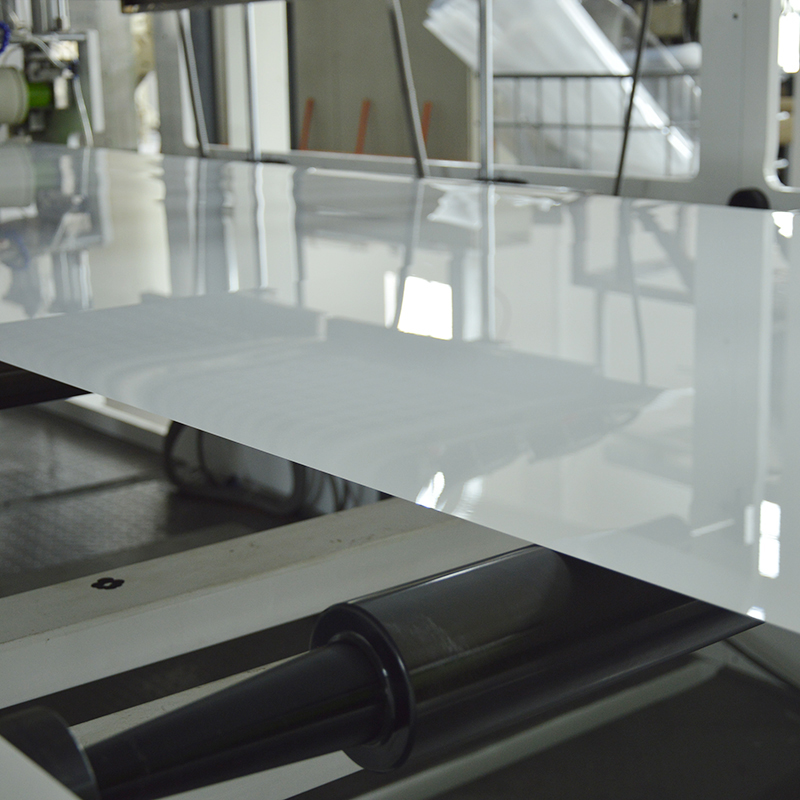
Achieving exceptional transparency requires precise thermal management during extrusion. The clarity of a Transparent PET Roll relies on the amorphous structure of APET (Amorphous Polyethylene Terephthalate). During manufacturing, the polymer melt is rapidly quenched on a chilled roller. This sudden cooling prevents the polymer chains from organizing into crystalline structures. Spherulites (crystalline formations) scatter light and cause opacity. Preventing their formation allows light to pass through with minimal interference. When measuring haze and gloss metrics using standard ASTM methods, APET consistently rivals glass. Low haze values ensure consumers see the product's true colors and textures without milky or cloudy distortion.
Tensile strength and impact resistance define how well packaging survives distribution. PET exhibits a remarkably high strength-to-weight ratio. It absorbs kinetic energy during drops and impacts, preventing the cracking and shattering commonly seen in alternative rigid plastics like Polystyrene (PS). This shatter resistance makes it vastly superior to glass regarding consumer safety and handling on the production line. Lighter packaging reduces the overall gross weight of shipments. A container thermoformed from PET weighs a fraction of its glass equivalent, drastically altering freight calculations and handling ergonomics.
Shelf-life extension depends heavily on controlling gas exchange. Oxygen Transmission Rate (OTR) and Water Vapor Transmission Rate (WVTR) are the critical metrics. PET provides a robust, inherent barrier against both oxygen and moisture, slowing down oxidation, lipid rancidity, and dehydration in perishable goods. Beyond standard atmospheric gases, the polymer resists a wide range of chemicals, including greases, oils, and dilute acids. This chemical resistance makes it highly versatile, suitable for everything from oily baked goods and cosmetics to acidic industrial components and automotive lubricants.
Property | Test Method | Typical Value for APET |
|---|---|---|
Light Transmission | ASTM D1003 | > 88% |
Haze | ASTM D1003 | < 2.0% |
Tensile Strength (Yield) | ASTM D882 | 7,000 - 9,000 psi |
Oxygen Transmission (OTR) | ASTM D3985 | 3 - 6 cc/100in⊃2;/24hr |
Polypropylene (PP) offers excellent heat resistance, making it the standard choice for microwaveable containers and hot-fill applications. However, PP naturally exhibits a hazy, translucent appearance due to its semi-crystalline nature. When optical clarity is the primary goal, PET wins decisively. PP does offer superior hinge-forming capabilities, allowing for living hinges in one-piece clamshells that can be opened and closed repeatedly without snapping. Conversely, PET provides better overall stiffness, structural snap, and a premium, glossy finish that PP cannot replicate.
Polyethylene (PE) film rolls are soft, flexible, and highly stretchable. They excel in applications requiring high puncture resistance in flexible pouches or shrink wraps. In contrast, PET delivers rigid structural support necessary for trays and blisters. PE features a significantly lower melting point, making it exceptionally easy to heat-seal using basic thermal jaws. Sealing PET requires higher temperatures, longer dwell times, or the application of specific heat-seal coatings (such as EVA) to achieve a secure, hermetic weld.
Biaxially Oriented Polypropylene (BOPP) is widely used for flow wrapping, snack bags, and overwrap films. BOPP provides an exceptional moisture barrier and high tensile strength in the machine direction, but it lacks the structural rigidity needed for rigid trays or deep-draw blisters. You specify a PET roll over BOPP when the packaging requires deep thermoforming capabilities, crush resistance, and a rigid feel.
Material | Optical Clarity | Structural Rigidity | Moisture Barrier (WVTR) | Heat Resistance | Primary Application |
|---|---|---|---|---|---|
PET | Excellent (Glass-like) | High | Good | Low to Moderate | Rigid Trays, Blisters, Clamshells |
PP | Poor to Fair (Hazy) | Moderate (Flexible Hinge) | Excellent | High (Microwaveable) | Hot-fill Containers, Hinged Boxes |
PE | Fair | Low (Flexible) | Excellent | Low | Flexible Pouches, Shrink Film |
BOPP | Good | Low (Film) | Excellent | Moderate | Flow Wraps, Snack Bags |
The deep-draw capabilities of PET allow manufacturers to create complex, custom-shaped cavities without thinning out the corners excessively. The material distributes evenly across the mold when heated to its forming temperature. Fresh produce, bakery items, and deli meats rely heavily on these rigid containers. The high visibility showcases the freshness of the food, driving grocery purchases. The structural integrity ensures that delicate items like berries or pastries are not crushed when stacked on retail displays.
Thinner gauges of PET serve perfectly as lidding films for pre-formed trays and cups. These films can be engineered for permanent weld-seals or consumer-friendly peelable seals. The clarity ensures that the consumer can inspect the contents for quality and portion size while maintaining a leak-proof barrier. In modified atmosphere packaging (MAP), PET lidding films help trap the specific gas mixture inside the tray, significantly extending the shelf life of fresh meats and prepared meals.
High-theft retail items and fragile electronics require robust protection. Blister packs formed from rigid PET deter tampering and shoplifting due to their tough, tear-resistant nature. The structural rigidity immobilizes delicate electronic components, preventing transit damage caused by vibration or impact. Furthermore, the glass-like clarity keeps the product fully visible to the buyer, allowing for clear reading of internal labels or inspection of the hardware without opening the package.
Medical-grade PET meets strict FDA and ISO compliance standards for direct contact with medical devices and pharmaceuticals. It handles specific sterilization methods required in the healthcare industry. While it withstands Gamma irradiation and Ethylene Oxide (EtO) sterilization well, packaging engineers must monitor potential color shifting or slight yellowing during prolonged radiation exposure. The absolute clarity of the material allows medical professionals to visually inspect surgical instruments and devices for integrity before breaching the sterile barrier in an operating room.
Selecting the correct mil or micron thickness is a critical engineering decision. Rigid thermoforming applications generally require thicker gauges to maintain structural integrity under stacking loads and vacuum forces. Flexible lidding films utilize much thinner gauges. Over-engineering thickness unnecessarily increases material usage, weight, and freight costs. Under-engineering risks package failure, crushing, or barrier compromise during distribution. Engineers must calculate the exact thickness required based on the product's weight, fragility, and expected supply chain stresses.
Application Type | Recommended Gauge Range | Key Engineering Consideration |
|---|---|---|
Lidding Films | 1.0 - 3.0 mil | Sealant layer compatibility and peelability |
Lightweight Blisters | 10.0 - 15.0 mil | Puncture resistance and flange stiffness |
Standard Clamshells | 15.0 - 25.0 mil | Hinge durability and snap-lock engagement |
Heavy-Duty Trays | 25.0 - 40.0 mil | Deep draw corner thickness and stacking strength |
Integrating new materials into existing FFS or thermoforming lines requires careful calibration of heating zones, forming pressures, and cutting stations. PET can generate static electricity and high surface friction when unrolling at high speeds. To prevent web snapping, unrolling issues, and static build-up, manufacturers often apply a microscopic silicone coating or incorporate anti-block additives directly into the polymer melt during extrusion. These treatments reduce the coefficient of friction, ensuring smooth feeding through high-speed machinery without compromising transparency.
The transition toward recycled PET (rPET) is accelerating rapidly across all packaging sectors. Incorporating post-consumer recycled content helps brands meet regulatory requirements and corporate ESG targets. Increasing the rPET percentage can introduce slight color variations, often a faint yellow or grey tint, and microscopic impurities. Advanced sorting, washing, and super-cleaning technologies now allow high-percentage rPET rolls to maintain excellent optical clarity and mechanical strength that is virtually indistinguishable from virgin APET.
PET possesses high surface resistivity, causing it to hold static charges and attract airborne dust particles. Dust ruins the transparent aesthetic, making the packaging look dirty and signaling poor quality to consumers. Specifying anti-static treatments is non-negotiable for high-end retail packaging. These can be applied as topical coatings during the extrusion process or mixed as internal additives. Anti-static agents draw ambient moisture to the surface of the film, dissipating the electrical charge and keeping the packaging pristine from the factory floor to the retail shelf.
Standard APET loses impact resistance at sub-zero temperatures, making it prone to shattering or cracking in blast freezers or cold-chain distribution. For frozen food applications or winter transport in extreme climates, engineers must evaluate modified variants. PETG (Polyethylene Terephthalate Glycol) incorporates glycol during polymerization, preventing crystallization and maintaining flexibility and durability in extreme cold. CPET (Crystallized PET) is another alternative designed specifically to withstand both freezing temperatures and oven heating.
Cutting rigid PET requires precise, sharp, and properly configured tooling. Dull blades or improperly angled cutting dies cause "angel hair"—fine, stringy plastic shavings that contaminate the packaging line and the product itself. Proper tooling optimization minimizes equipment downtime and prevents plastic particulate contamination.
Follow these tooling maintenance steps to prevent angel hair and rough edges:
Inspect match-metal dies daily for micro-abrasions and alignment issues.
Maintain strict temperature control on heated cutting stations to ensure clean shearing.
Replace steel rule dies before they show visible dulling or edge rolling.
Adjust cutting pressure dynamically based on the specific gauge of the roll stock being processed.
Request material samples in various gauges to test clarity, rigidity, and deep-draw capabilities on your specific forming equipment.
Review the Technical Data Sheets (TDS) to confirm OTR, WVTR, and tensile strength metrics align perfectly with your product's shelf-life requirements.
Schedule a line trial with your machinery manufacturer to optimize heating zones, web tension, and cutting dies for the new material.
Consult with a packaging engineer to determine the optimal rPET percentage for your specific application and corporate sustainability targets.
A: APET is standard amorphous polyethylene terephthalate, offering high clarity and rigidity for general packaging. PETG includes glycol, making it softer, easier to die-cut, and highly impact-resistant, especially in cold temperatures. CPET is crystallized, designed to withstand extreme heat, making it suitable for dual-ovenable microwave and conventional oven trays.
A: Thicker gauges require more thermal energy to reach their forming temperature, which extends the heating dwell time and slows down the overall cycle time. Thinner materials heat and cool faster, allowing for higher throughput on the thermoforming line.
A: Yes, virgin APET and properly super-cleaned rPET are FDA-approved for direct food contact. They do not contain BPA or phthalates, making them safe for packaging fresh produce, bakery items, deli meats, and beverages.
A: Standard PET requires high temperatures and precise dwell times to weld to itself. For reliable, high-speed sealing, especially to other materials, PET rolls are typically co-extruded or coated with a heat-seal layer, such as EVA or PE, to lower the sealing activation temperature.
A: Standard APET begins to soften and deform at temperatures around 140°F to 160°F (60°C to 70°C). It is not suitable for hot-fill applications, microwaving, or environments where it will be exposed to boiling water or high radiant heat.
A: Anti-block additives introduce microscopic particles to the film's surface to reduce friction and prevent layers from sticking together. While essential for machinability, excessive anti-block can slightly increase the haze level of the film, marginally reducing its glass-like optical clarity.


